Top Game Design Interview Questions (And How to Answer Them)

With an unprecedented number of people interviewing in the games industry nowadays, I thought now would be a good time to write up some interview questions to be prepared for, as well as general interview tips. Since I’m a game designer, these are largely going to be focused on the design side, but many of them likely apply to other disciplines as well.

Common Interview Questions

I’ve been through multiple interview loops for various senior positions in the design space in the past 6 months, ranging from technical design to lead design to mission design. Here are some of the most common interview questions I’ve been asked (And that you should be prepared for!), as well as some tips for answering them:

  • Give an intro/high level job history
    • This will vary from person to person. Be sure to focus on anything relevant to the position you’re applying for, and highlight anything particularly impressive you’ve done or had a part in. Keep your answer within 3-5 minutes. Be sure to practice this one – I’ve been asked it in virtually every interview I’ve had recently.
  • Why do you want to work at (New company)?
    • Focus on the games/projects the company has worked on, and explain why you’d like to work on those – Were they well received? Are they games you’ve loved to play, or would like to play? Even if they don’t specifically ask, I tend to follow this up by diving into why the company and position seem like a good fit for me. Maybe the company’s website mentions they really care about personal growth, or that they foster a culture that encourages helping each other out. If the position is highly technical in nature, I’m sure to mention I have a background in programming and love solving problems.
  • Why are you leaving (Current company)?
    • Be sure to keep this positive. If you’re leaving your job for a negative reason, maybe focus on something that it’s not providing you that a new opportunity might – Location, company culture, growth, etc.
  • What are you looking for in a new job?
    • Ideally, focus on things you’ve seen in the job description or on their website. Some things I typically mention are: Growing and learning, autonomy, and working on a game that’s well received by players.
  • What’s your process of making a mission from start to finish?
    • This answer generally has a lot of parts that I need to dig into, but here are some things to think about:
      • Design pillars/theme of the mission (Or game as a whole)
      • Why is this mission is being made (eg, tutorial, introducing a new character, etc)
      • Make sure to hit any beat(s) from narrative team
      • What mechanics are in the game and how they can be used in cool/unique ways
      • What characters can be present and how can the gameplay progress their story or show their personality
      • Start with a core idea and make a prototype
      • Get feedback from team/playtests and iterate accordingly
      • Build up the mission in phases while getting feedback along the way
      • Get other people to review you mission and provide feedback
      • How does the specific mission fit into the game as a whole
      • Variety and pacing are very important (Both within the mission and for the game as a whole)
  • Tell me a story about communicating with other teams
    • This question gets asked in all sorts of different ways, but it basically boils down to explaining how you handle communicating with others (Especially across different departments). Depending on how they ask the question, I like to mention that mission design tends to be the interdisciplinary intersection point of the team, so I have tons of experience working with other departments – Engineering, art, audio, producers, QA, other designers, etc. If you don’t have that same experience, you could talk about how you listen to other people’s area of expertise and try to incorporate that into your design. You could also mention that you listen more than you talk, or how you ask questions instead of being judgmental when disagreements arise.
  • How do you handle giving/receiving feedback?
    • Again, this question gets asked all sorts of ways. Giving and receiving feedback is extremely important in the games industry. I always start by mentioning I never take feedback personally – I see it as a chance to grow and get better. I then talk about how often I hear a piece of feedback, and who is giving the feedback, and how I take those into consideration. Finally, I explain that getting to the heart of someone’s feedback (Rather than directly implementing what they ask for) is extremely important, because they might not even know exactly what they want or how a simple change might affect other systems.
  • What’s your expected salary?
    • Pretty obvious, but most recruiters will ask you this in your first interview to make sure you’re aligned when it comes to compensation. I always phrase this like so: “I’m open to negotiation, but I’m looking for somewhere between x and y.”
  • Do you have any questions for us?
    • Another obvious one, but most interviews end with you having a chance to ask them questions. I try to keep these relevant to their job titles. I might ask a recruiter, “What are the top 3 things you’re looking for in a candidate?” If I’m talking to producers, I might inquire, “What are the top priorities for the team in the next, 6-12 months?” If I’m talking to a fellow mission designer, I might go with, “How much creative ownership do you have over your missions?” Keeping the questions relevant to their experience ensures they’re more engaged, and shows that you know how to communicate across different disciplines.
  • What games are you playing/do you like to play?
    • This questions tends to be asked either at the beginning as an ice breaker, or at the end to wind down the interview. If applicable, try to select a few games that are at least semi-related to the games they make, since it shows you enjoy playing the games you’d be making.

Less Common Questions

These questions have been asked multiple times, but not necessarily in every interview.

  • What are some of your favorite missions in games?
    • This is going to vary from person to person, but come up with some shining examples of great mission design. If their company is very mechanics-focused, you could go with some examples that have unique or interesting mechanics. If they’re very story-focused, you could choose some that show rich narrative or character development. Oh, and in case you were wondering, my answer is: Redmaw (Horizon Zero Dawn), Suicide Mission (Mass Effect 2), and The Ashtray Maze (Control).
  • What is the most technically complex thing you’ve worked on?
    • Again, this will vary from person to person, but pick something that’s complex, interesting, and that you can talk about the intricacies of. When I answer this, I always mention (Half jokingly) doors, because of The Door Problem, but then I follow it up with stuff that sounds more complex, like a roguelike game mode I designed and implemented, a 3D graphics engine I coded in C++, or a self-driving car I made in college.
  • Tell me about a time you disagreed with your lead (And/or someone on another team). How did it go, and how was it resolved?
    • People have different opinions on how to solve problems all the time. Pick an example that shows how you handled the situation well. Did you request a short amount of time to make a prototype of your idea so you could see it in-engine? Did you make a pros and cons list of both options, then discuss each option with the stakeholders? Did you “disagree but commit?” (ie, voice your concerns to make sure you were heard, then followed what your lead told you to do?) There are positive ways to handle disagreements, so make sure your answer highlights one of those times.
  • Tell me about a time you failed
    • This one can be hard to answer on the spot, so I highly recommend coming up with something ahead of time. Try to find a story that shows that you really learned something or grew from your experience. If you don’t have a story like that, try to pick something from early in your career, and highlight how you’d do it differently now. No one wants to work with someone that makes the same mistakes over and over again.

General Interview/Job Finding Tips

All right, so you know what questions to be prepared for, but what about execution? And what about finding jobs? Here are some quick tips for people looking for jobs in the games industry:

  • Be prepared (Check and check!)
  • Stay calm. Interviews can be nerve-racking. It always helps me to remember that I’m just having a chat with another person (And someone that probably likes games as much as I do).
  • Ask clarifying questions if needed. Not only does this help with communication, but it also gives you a short bit to formulate your answer.
  • Highlight your thought process. Interviewers are looking for how you solve problems and your work philosophies, so skipping straight to the answer isn’t ideal.
  • Take notes immediately after the interview and learn from your mistakes, or think up better answers for next time. This is particularly helpful if you have multiple interviews with the same company.
  • Lean on your network. People seem to be more happy than ever to help out others looking for work. Even if they can’t give you a recommendation, they might be able to send new jobs they hear about.
  • Have a friend give you a mock interview and provide feedback.
  • Don’t ever assume you’ve got a job in the bag – Anything can happen, even up until the last moment, especially right now in the industry. Keep applying until you sign the paperwork. Worst case scenario, a company reaches out and you say you’ve already started at a new job.
  • For Zoom interviews, consider having a document open on another monitor with a bunch of these questions/answers ready in case your brain goes blank during the interview. Just make sure you don’t seem like you’re reading your answers as that can be off-putting.

Final Thoughts

When I was younger, my mom told me finding a job takes an average of about 6 months. At the time, I thought she was crazy, but that has actually been my experience throughout the years. With the games industry being in such a rough place right now, I’d even push expectations to 6 – 12 months. I’ve heard back from a lot of companies saying they received hundreds or even thousands of applications for a single position. With that many applicants, the competition is strong even for those with decades of experience. The only advice I can give is don’t give up – If you’re passionate about making games, keep at it, and don’t let rejections get you down. Be persistent, apply everywhere you can, and learn from your mistakes, and you’ll land a job before you know it.

Grapplers: Relic Rivals Released!

My indie game, Grapplers: Relic Rivals, released today on Steam and itch.io!

Launch Trailer: https://youtu.be/9R29xftbmpk

Steam: https://store.steampowered.com/app/2906890/Grapplers_Relic_Rivals/

The game was made by Paul Kankiewicz (That’s me!) (Game designer/programmer/wearer-of-many-hats), Nicolas Pava (Artist) and Lukas Raymond (Sound designer) in ~8 months using GameMaker. Check it out, and have fun playing!

Grapplers: Relic Rivals Release Date Announcement

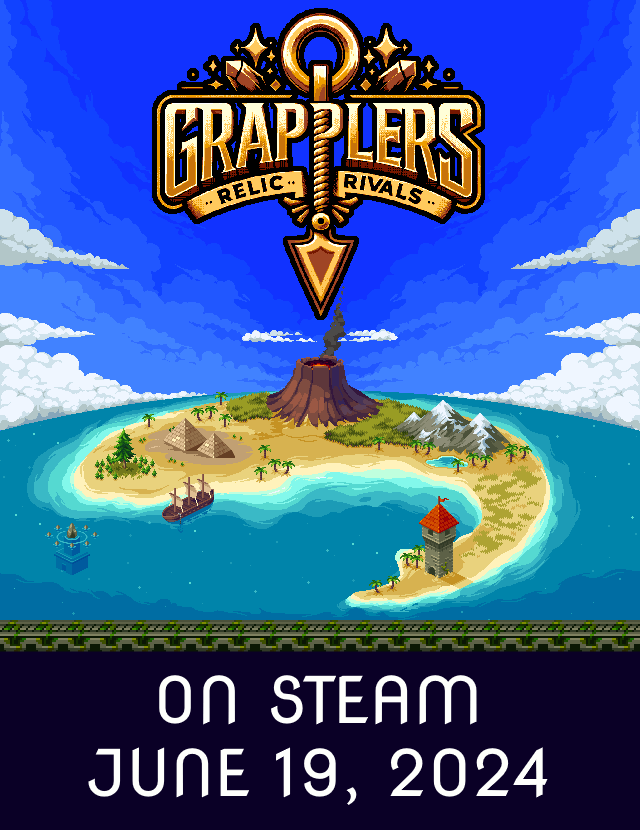
The wait is over, treasure hunters! I’m incredibly excited to announce that Grapplers: Relic Rivals will be releasing on Steam June 19, 2024!

Steam page: https://store.steampowered.com/app/2906890/Grapplers_Relic_Rivals/
Grapplers: Relic Rivals – Steam Announcement!

After quite a few months of getting the art updated and pouring over tons of design details, I’m elated to announce that the Steam page for Grapplers: Relic Rivals is now live!

https://store.steampowered.com/app/2906890/Grapplers_Relic_Rivals

You have no idea how much simply wishlisting the game can help! Grapplers: Relic Rivals will be releasing on Steam in summer 2024!

Ally Productions is Looking for a Pixel Art Generalist (Paid Contract)

Current position status: CLOSED

The Position

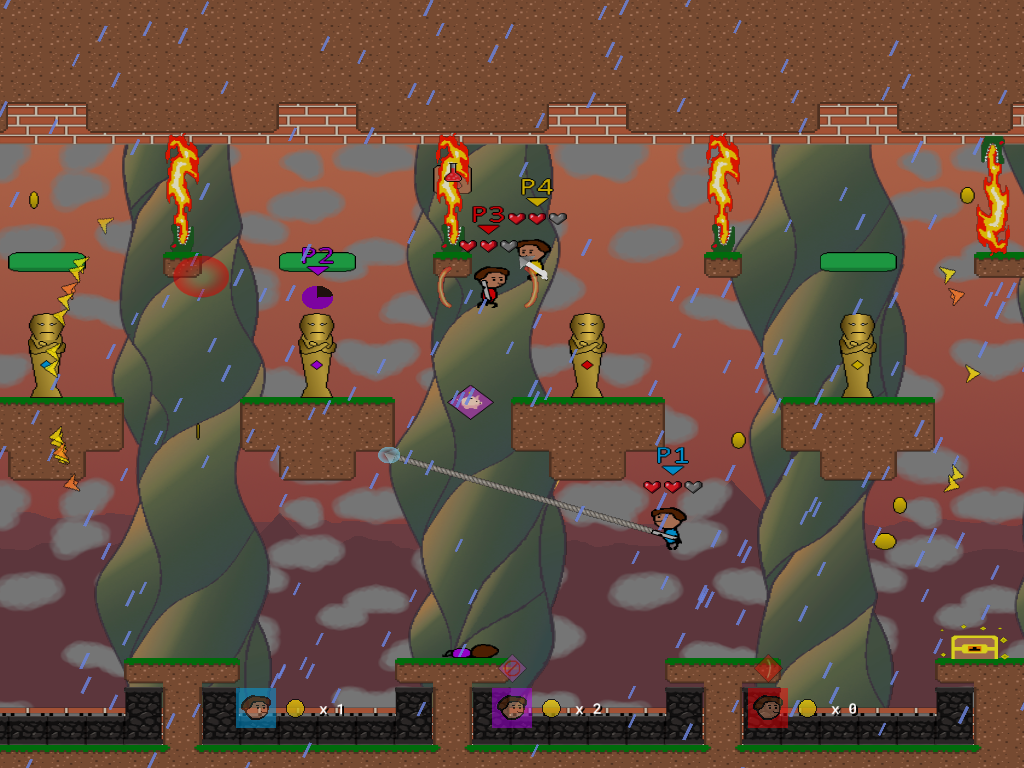
Ally Productions is looking for a 2D pixel art generalist for a short term, paid contract for Grapplers: Relic Rivals, my upcoming 2D PVP platformer with grappling hooks. All art in the game is currently temp, so your job would be updating the existing art with Real Art™, and creating new art for anything new that gets made.

The ideal candidate would meet all of these criteria, but I’m open to any interested candidate:

  • You can create beautiful 2D pixel art (eg, Celeste, Terraria, Stardew Valley, Megaman X, TowerFall Ascension).
  • You are versed in multiple kinds of art. In order of importance: Characters, environment tilesets and backgrounds, animation, UI, Steam page assets, minor VFX, maybe social media banners.
  • You know how to keep communication lines open and are not be afraid to get clarification on details. Communication is very important to me.

I’m hoping to have the game done by ~May 1, 2024, but I encourage you to reach out even if the timeline doesn’t quite fit and we can talk things out. That said, this is a small project, so while quality is still important, I’m focused on speed first.

About Grapplers: Relic Rivals

Grapplers: Relic Rivals is a 2D PVP platformer with grappling hooks, similar to Smash Bros (With a single character type) or TowerFall: Ascension. The game is currently at alpha, meaning all of the main mechanics should be more or less represented even if they’re buggy or more content needs to be created for them (eg, more levels). For more info:

  • Download and play the Alpha Build.
  • Check out my devlogs.
  • Email me with questions (See info below).

About Ally Productions

Ally Productions is currently just me, Paul Kankiewicz (he/him), but I’ll soon be adding an artist and sound designer to my team. I released Open Ocean in 2019, which is an extremely small game with a powerful environmental message. I’m currently working on Grapplers: Relic Rivals.

For more info about me, check out my About Me page.

How To Apply

EDIT: This positions is now closed.

Interested in this position? Email [email protected] with your name, a brief introduction, and a link to your portfolio and let’s talk! Please use the subject line “Grapplers: Relic Rivals Artist Application” to ensure your portfolio gets looked at.
Grapplers: Relic Rivals – Alpha Playtest Build!

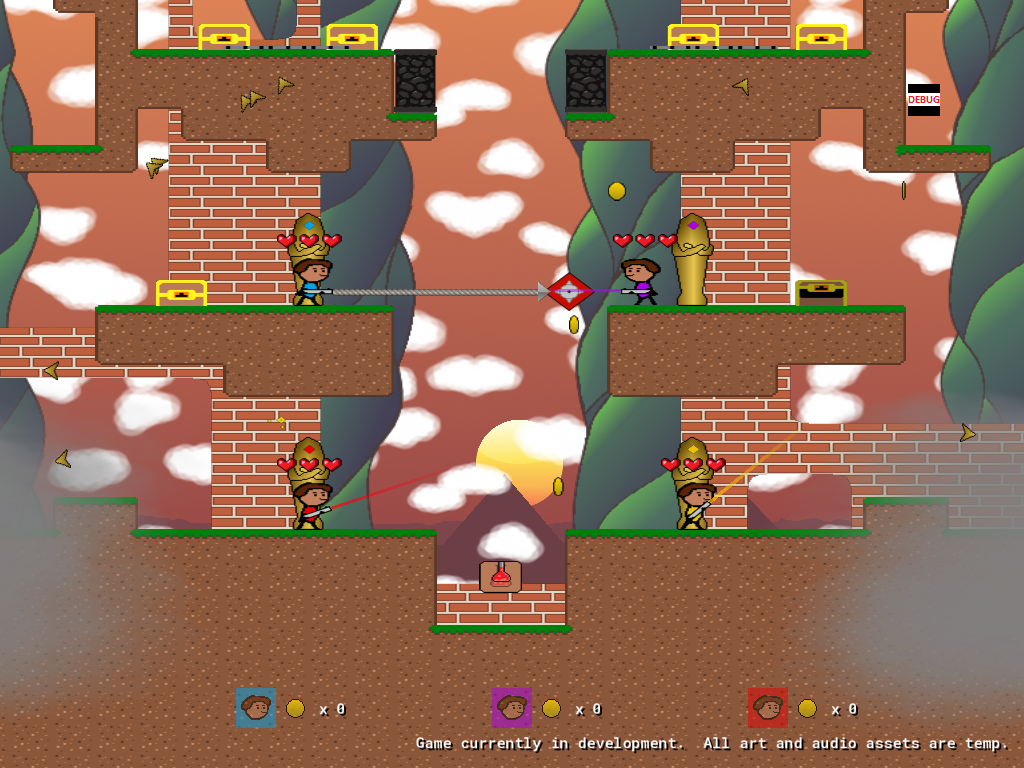
After a few months of hard work, Grapplers: Relic Rivals is ready for an alpha playtest! The alpha build can be downloaded on itch.io here. I also created a survey to gather playtest feedback. If you play the game, I’d appreciate you letting me know what you think – Good, bad, or otherwise.

Keep in mind the game is currently at alpha, so the art and audio are currently temp and the game is still under development, but all the main mechanics should be more or less represented, even if they’re buggy or more content needs to be created for them (eg, levels).

If you’d like to stay up to date on the project, you can check out my devlogs here.

Untitled PVP Grapple Game – First Playable Playtest Build!

Work on my indie game – a 2D PVP platformer with grappling hooks – has been going extremely well lately! So well, in fact, that I’m ready to invite people to playtest the first playable build! Much of the game is still being stood up, so the gameplay is a little bare-bones, but I find it’s important to get feedback early and often. There’s enough of the game that’s been built now that it’s time to hear what others have to say about it!

The build can be downloaded on itch.io here. I also created a survey to gather playtest feedback.

In addition to working on the game, I’ve been creating devlogs to showcase my weekly progress. If you’d like to check them out, you can find those here.

Random Generation Done Right

Diablo 2 will forever be one of my favorite games. There are many aspects of the game that they just got right – Itemization, skill synergies, and the variety of monsters (Including affixes), to name a few. But one of the best things about it was its randomly generated maps. The ever-changing landscape kept the game feeling fresh even after thousands of hours.

Fast forward 23 (!) years: I played a lot of Diablo 4 at and around launch, and while I really loved the variety of builds and the constant drip of progression (Skill tiers, class skills, paragon boards, legendary affixes, etc), one of the areas I thought fell short was the random generation of their dungeons. Here are some examples of randomly generated dungeon layouts in Diablo 4:
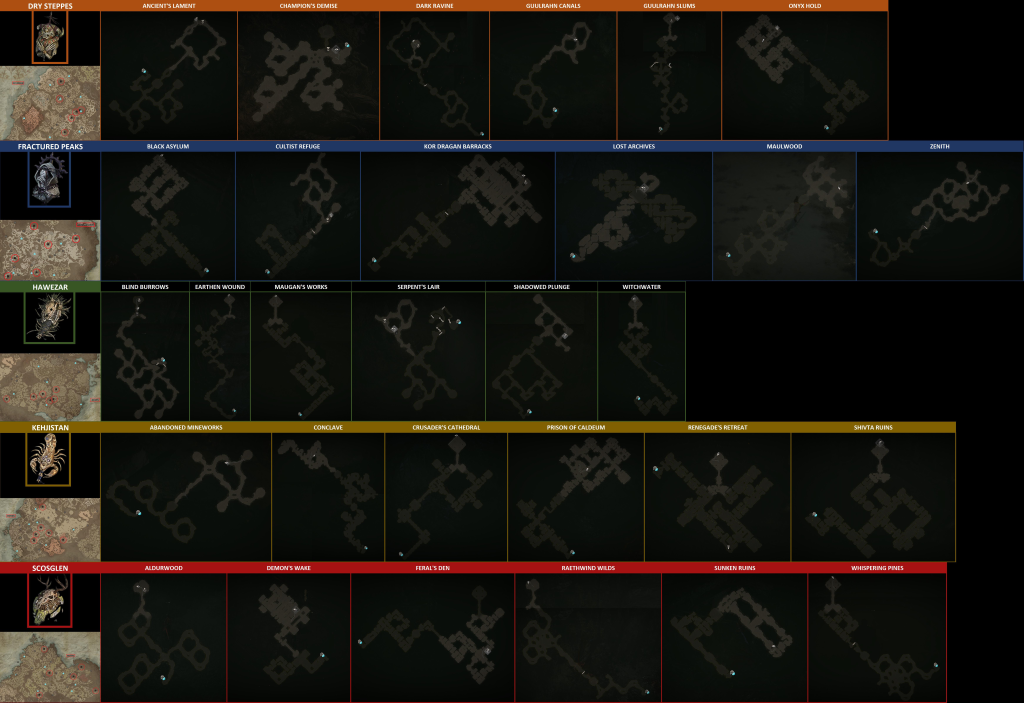
These aren’t inherently bad, but something that really stands out is that the grid is extremely visible, something designers should aim to eliminate in today’s age of random generation. The loops and chunks used to generated the levels are also obvious, leading to players easily noticing repeats.

So how can we make this better? Sometime around 2020, I worked on randomly generated “dungeons” in a AAA 3D action game. While doing so, I did a lot of research into how various games randomly generate dungeons and mocked up some 2D prototypes of what the randomly generated spaces could look like using GameMaker. My first iteration looked something like this:
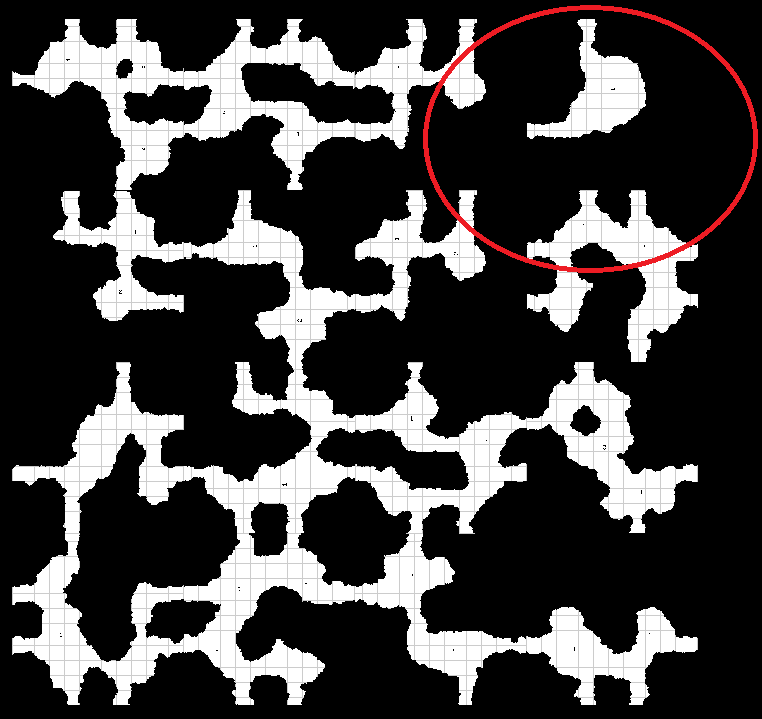
(Ignore the red circle – That was just showing that some chunks aren’t connected to the rest of the dungeon. Remember, this was just a prototype to prove out an idea, so it didn’t need to be perfect).

Okay, so that attempt wasn’t great. The grid is obvious, and since chunks are just rotated, repeated chunks are extremely easy to spot even in a small 4×4 dungeon like this. But making games (And prototypes) is an iterative process. Let’s see if we can do better! Here’s the second iteration:
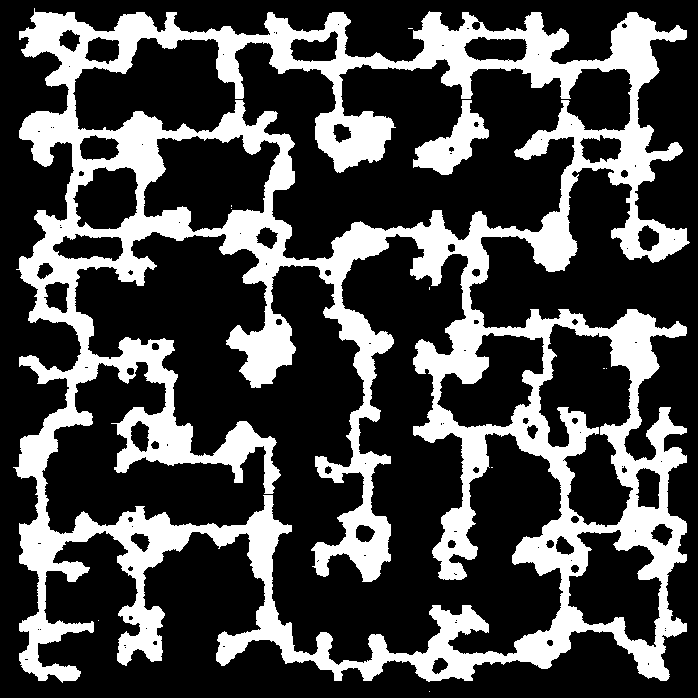
All right, that’s a little better, but it still has some of the issues mentioned above. The grid is still extremely obvious. But repeated chunks are a bit harder to spot due to the addition of black circles randomly within each chunk. In the final game, you could imagine these being any sort of blocker to break up the space a little differently, even when the same chunk is used – Boulders, pillars, statues, holes, quicksand, trees, etc. I call things like this “axes of randomness” – The more ways in which we can make an experience random, the harder it will be for players to notice repeated content. See below for more examples.

So we’ve made some progress, but let’s see if we can do even better! Here’s the final iteration of the prototype:
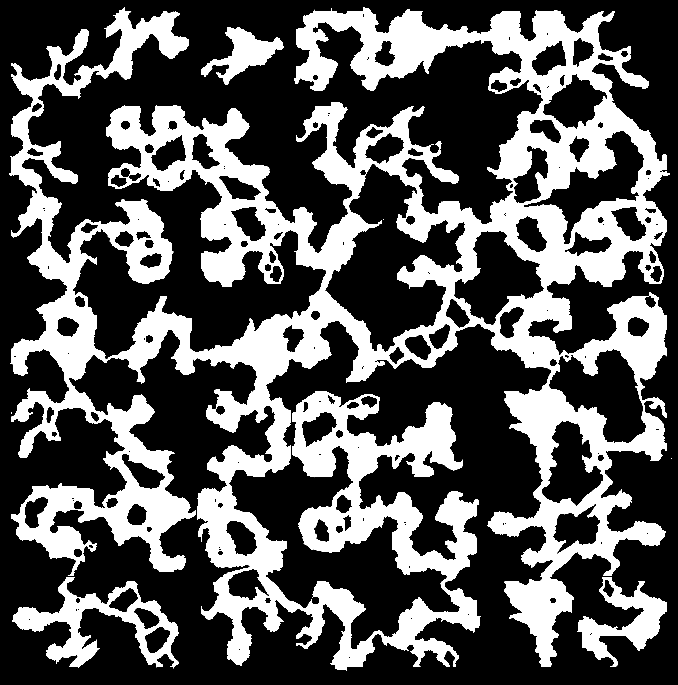
Looks pretty good, right? Using more organic-looking chunks, I was able to mask the fact that the chunks are placed on a grid. The random rotations and the randomized black circles help hide the fact that there are repeated chunks, even in a 7×7 grid like this and using just 20 unique chunks. At this point, we decided the idea was worth pursuing in the real game, so I got to work building the real thing, but here are some more improvements that could have been made to these maps and the actual spaces within the game:

  • Create more unique chunks used to generate the spaces. This only used 20 unique chunks, so we were guaranteed duplicates in a 7×7 dungeon like the prototype.
  • Make sure that the same chunk never appears in the same dungeon with the same rotation (Or maybe at all, if you have enough unique chunks).
  • Clean up the randomized circles so they’re placed in better areas, as opposed to randomly.
    • For example, we could use them to block off paths so traversal through the space was different even when the same chunk is used.
  • Add additional axes of randomness to mask the times when the player sees the same chunk.
    • Randomize enemy placements, types, and number within each chunk.
    • Randomize the textures that each dungeon (Or chunk) uses.
    • Randomize environmental effects – Fog, lighting, weather, spores, dripping water, etc. within each chunk (Or in the dungeon as a whole).
    • Randomize puzzle placement and type within each chunk.
    • Randomize trap placement and type within each chunk.
  • Block off exits that don’t lead anywhere with rocks (ie, a cave in), vines, walls, magic barriers (Like in Gunfire Reborn), etc.
  • This would be a bit more expensive, but when connecting these in 3D, you could use non-axis-aligned rotations and simply connect the entrances using something like sockets, allowing you to rotate these chunks at “any” arbitrary angle and escaping from the grid entirely.

In case you’re curious, here are the 20 unique chunks used in the final version:
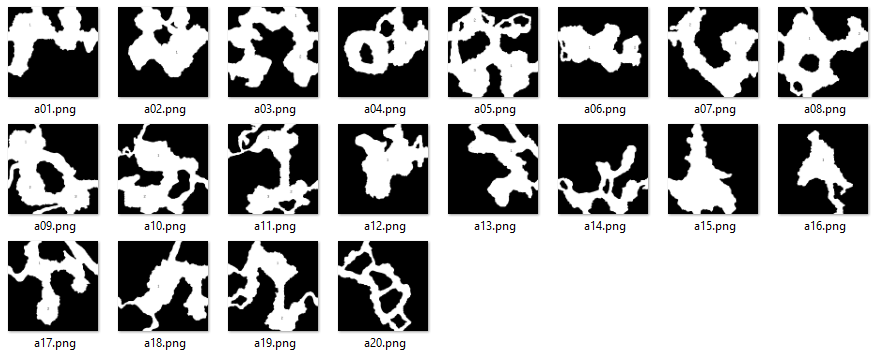
Fun fact: The “dual entrance” design was inspired by Castles of Mad King Ludwig, a board game recommended by my lead when I started these prototypes.

Now, these are all just prototypes, but the bones of the design are definitely present, and turning this into a finished product is totally doable. Going back to Diablo 4, it’s not that Blizzard did a terrible job with their randomly generated dungeons – They’re fine enough and get the job done, and certain dungeons definitely have a different feel to them (I particularly enjoyed the Flooded Depths). My main gripe is that their dungeon maps are obviously gridded and have the tell-tale signs of being randomly generated, which I never really noticed in Diablo 2, a game the same company made over 20 years ago! Nowadays, with a little work we can do wonders to hide these things from players, making the dungeons feel much more organic and realistic. The Diablo series used to be at the forefront of random generation, so it’s a bit sad to see Diablo 4 fall a bit flat in that area.

My New Adventure

After much deliberation, I decided to leave my job at BioWare to try my hand at indie game development, which has always been a dream of mine. While I have no delusions that going indie poses its own challenges, I’m extremely excited to take creative control into my own hands and to be able to make the decisions I feel will lead to the best game. The change in scale of the games I’ll be making warrants a change to my current quest:

New quest: Ship an indie game on Steam with Very Positive reviews.

Be sure to keep an eye out on this space for future updates!